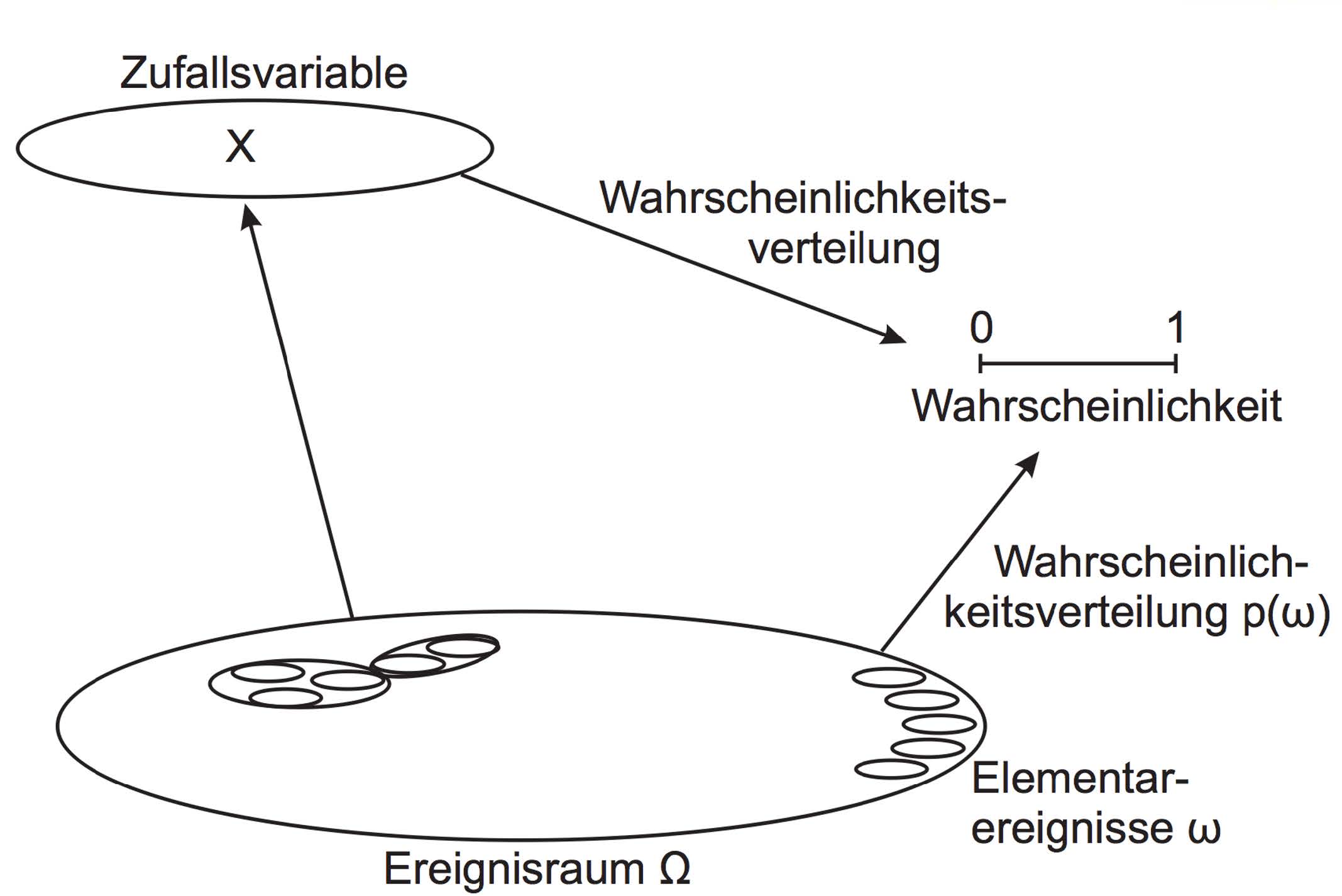
Zufallsvariable\(X\): Variable die den Ergebnissen eines Zufallsexperiments Werte (Realisierungen) zuordnet
Wahrscheinlichkeit\(P\): theoretische Häufigkeit, mit der ein Ereignis in einer grossen Anzahl gleicher, wiederholter, voneinander unabhängiger Zufallsexperimente auftritt (z.B. 0.5 für Zahl beim Münzwurf)
Ereignisraum\(\Omega\): Alle theoretisch möglichen Ereignisse, denen sich Wahrscheinlichkeiten zuordnen lassen
Elementarereignisse\(\omega\): Ergebnis eines Zufallsexperiments
Wahrscheinlichkeitsfunktion\(f(x)\): Funktion, die jedem Ereignis \(\omega\) eine Wahrscheinlichkeit \(P(\omega)\) zuordnet
Verteilungsfunktion\(F(x)\): Funktion, die die Wahrscheinlichkeit angibt, dass die Zufallsvariable \(X\) einen Wert kleiner oder gleich \(x\) annimmt
Wahrscheinlichkeitsverteilung\(p(\omega)\): Wahrscheinlichkeit, dass das Ereignis \(\omega\) eintritt
library(ggplot2)library(dplyr)library(gridExtra)# Funktion zum Berechnen der Wahrscheinlichkeits- und Verteilungsfunktionensimulate_dice <-function(n_dice) { rolls <-replicate(1000000, sum(sample(1:6, n_dice, replace =TRUE))) # Simulation von n_dice Würfeln df <-as.data.frame(table(rolls) /length(rolls)) %>%rename(x = rolls, probability = Freq) %>%mutate(x =as.numeric(as.character(x))) %>%arrange(x) %>%mutate(cumulative_probability =cumsum(probability))# Zusätzliche Punkte für 0 und 1 df <-rbind(data.frame(x =0, probability =0, cumulative_probability =0), df,data.frame(x =max(df$x) +1, probability =0, cumulative_probability =1))return(df)}# Daten für 1 Würfeldf_1dice <-simulate_dice(1)# Plot für die Wahrscheinlichkeitsfunktion (PDF) von 1 Würfelplot_pdf_1 <-ggplot(df_1dice, aes(x = x, y = probability)) +geom_bar(stat ="identity", fill ="skyblue", color ="black", width =0.7) +labs(title ="ein Würfel (PDF)", x ="x", y =expression(f(x))) +theme_minimal() +ylim(0, max(df_1dice$probability, na.rm =TRUE) *1.1) +xlim(0, 7) +scale_y_continuous(breaks =seq(0, 1/6, by =1/6),labels =c("0", "1/6"))# Plot für die kumulative Verteilungsfunktion (CDF) von 1 Würfelplot_cdf_1 <-ggplot(df_1dice, aes(x = x, y = cumulative_probability)) +geom_step(linewidth =0.8, color ="black") +labs(title ="ein Würfel (CDF)", x ="x", y =expression(F(x))) +theme_minimal() +ylim(0, 1) +xlim(0, 7) +scale_y_continuous(breaks =seq(0, 1, by =1/6),labels =c("0", "1/6", "2/6", "3/6", "4/6", "5/6", "6/6"))# Anordnung der beiden Plots in einem 2x1-Layoutgrid.arrange(plot_pdf_1, plot_cdf_1, ncol =2)
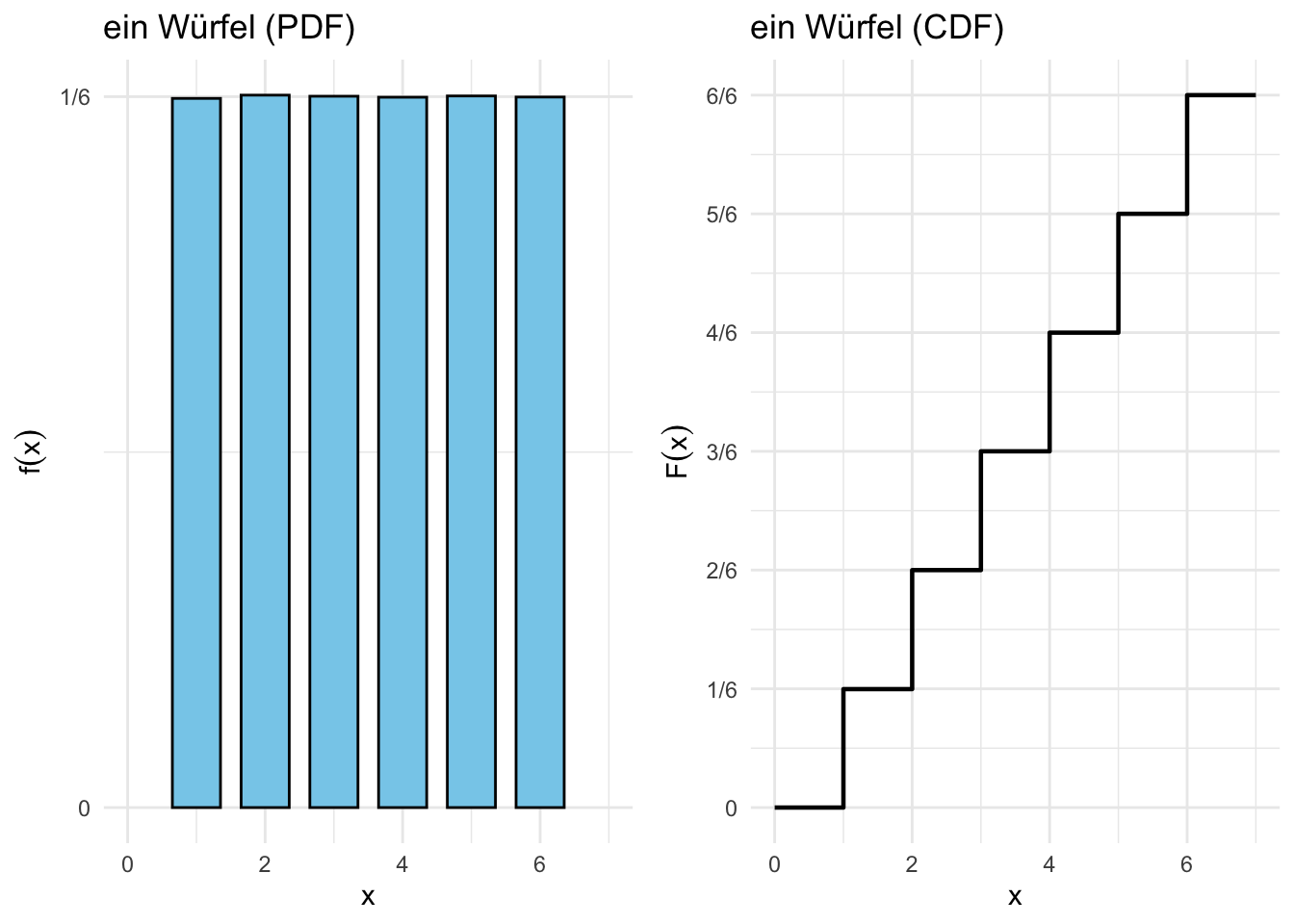
Abbildung 7.1: Diskrete Wahrscheinlichkeits- und Verteilungsfunktionen für einen Würfel (Berechnet mit 1’000’000 Simulationen)
Code
library(ggplot2)library(dplyr)library(gridExtra)# Funktion zum Berechnen der Wahrscheinlichkeits- und Verteilungsfunktionensimulate_dice <-function(n_dice) { rolls <-replicate(10000, sum(sample(1:6, n_dice, replace =TRUE))) # Simulation von n_dice Würfeln df <-as.data.frame(table(rolls) /length(rolls)) %>%rename(x = rolls, probability = Freq) %>%mutate(x =as.numeric(as.character(x))) %>%arrange(x) %>%mutate(cumulative_probability =cumsum(probability))return(df)}# Daten für 2, 3 und 4 Würfeldf_2dice <-simulate_dice(2)df_3dice <-simulate_dice(3)df_4dice <-simulate_dice(4)# Plots für die PDF und CDF von 2 Würfelnplot_pdf_2 <-ggplot(df_2dice, aes(x = x, y = probability)) +geom_bar(stat ="identity", fill ="skyblue", color ="black", width =0.7) +labs(title ="zwei Würfel (PDF)", x ="x", y =expression(f(x))) +theme_minimal() +ylim(0, max(df_2dice$probability, na.rm =TRUE) *1.1)plot_cdf_2 <-ggplot(df_2dice, aes(x = x, y = cumulative_probability)) +geom_step(linewidth =0.8, color ="black") +labs(title ="zwei Würfel (CDF)", x ="x", y =expression(F(x))) +theme_minimal() +ylim(0, 1)# Plots für die PDF und CDF von 3 Würfelnplot_pdf_3 <-ggplot(df_3dice, aes(x = x, y = probability)) +geom_bar(stat ="identity", fill ="skyblue", color ="black", width =0.7) +labs(title ="drei Würfel (PDF)", x ="x", y =expression(f(x))) +theme_minimal() +ylim(0, max(df_3dice$probability, na.rm =TRUE) *1.1)plot_cdf_3 <-ggplot(df_3dice, aes(x = x, y = cumulative_probability)) +geom_step(linewidth =0.8, color ="black") +labs(title ="drei Würfel (CDF)", x ="x", y =expression(F(x))) +theme_minimal() +ylim(0, 1)# Plots für die PDF und CDF von 4 Würfelnplot_pdf_4 <-ggplot(df_4dice, aes(x = x, y = probability)) +geom_bar(stat ="identity", fill ="skyblue", color ="black", width =0.7) +labs(title ="vier Würfel (PDF)", x ="x", y =expression(f(x))) +theme_minimal() +ylim(0, max(df_4dice$probability, na.rm =TRUE) *1.1)plot_cdf_4 <-ggplot(df_4dice, aes(x = x, y = cumulative_probability)) +geom_step(linewidth =0.8, color ="black") +labs(title ="vier Würfel (CDF)", x ="x", y =expression(F(x))) +theme_minimal() +ylim(0, 1)# Anordnung der Plots in einem 3x2-Layoutgrid.arrange(plot_pdf_2, plot_pdf_3, plot_pdf_4, plot_cdf_2, plot_cdf_3, plot_cdf_4, ncol =3, nrow =2)
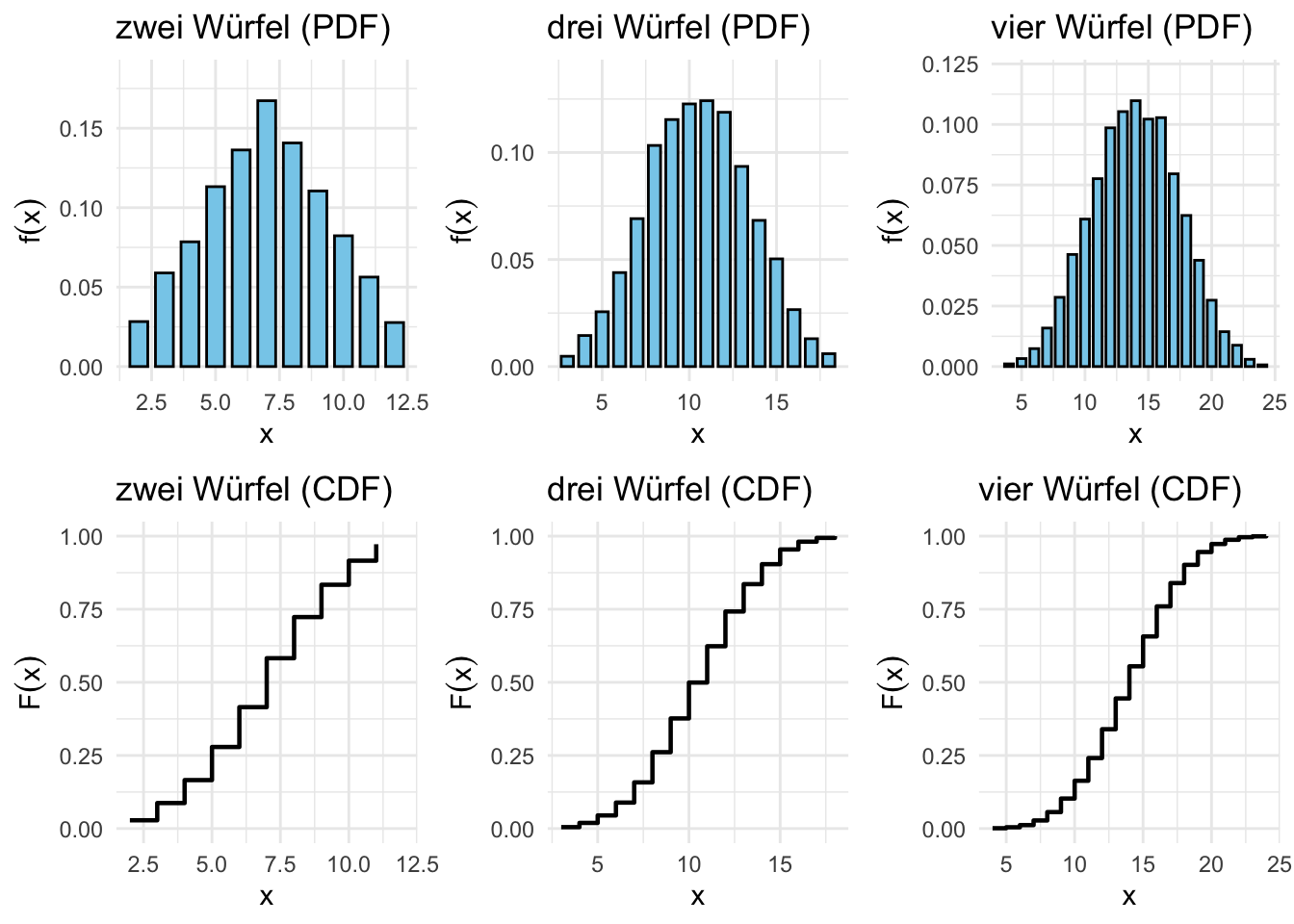
Abbildung 7.2: Diskrete Wahrscheinlichkeits- und Verteilungsfunktionen für 2, 3 und 4 Würfel (Berechnet mit 100’000 Simulationen)
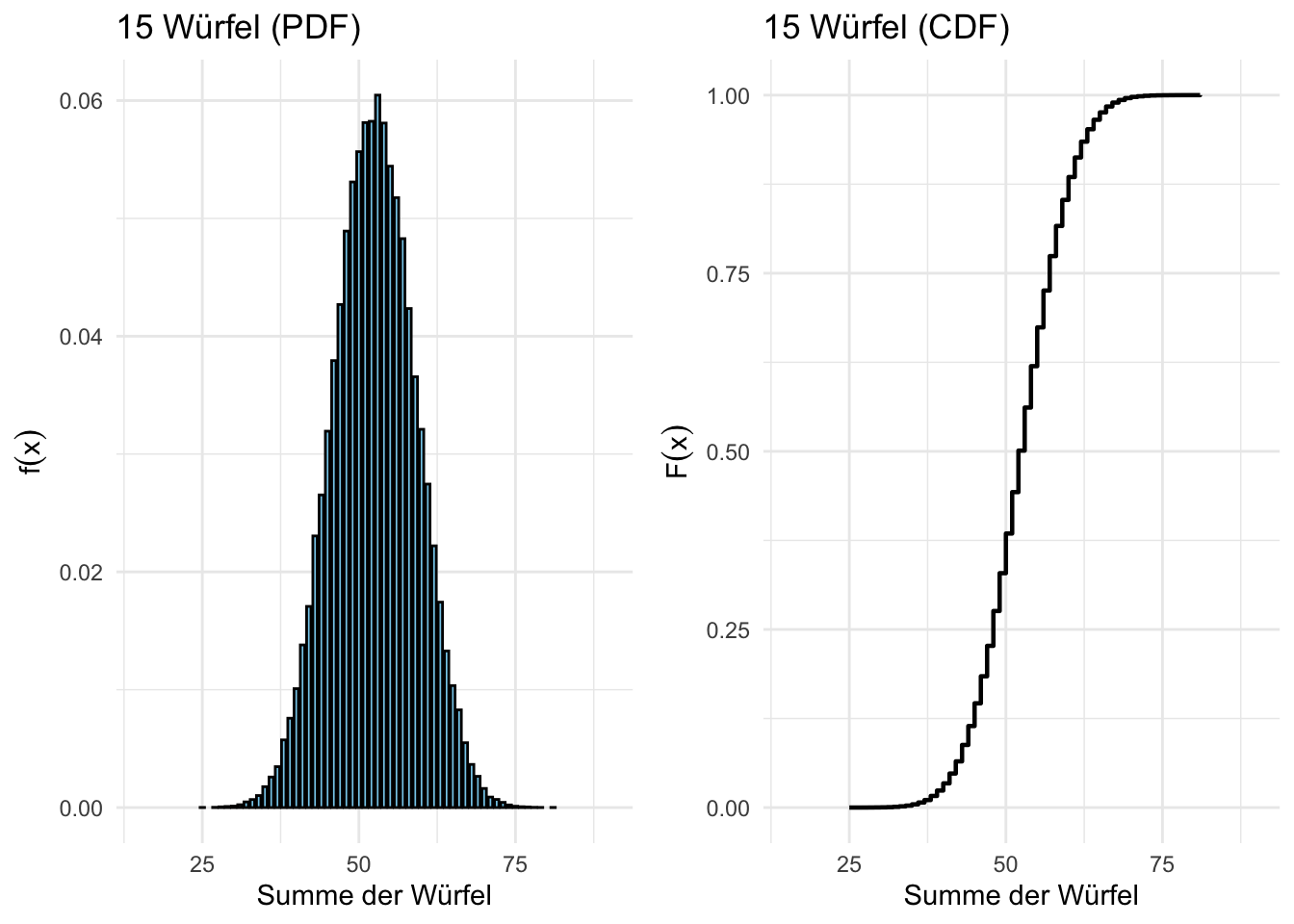
Mit mehr Würfeln kommt das immer näher an eine Normalverteilung
Code
# Lade benötigte Paketelibrary(ggplot2)library(dplyr)library(gridExtra)# Parameter definierenn_dice <-15# Anzahl Würfeln_simulations <-100000# Anzahl Simulationen# Dynamische xlim basierend auf minimaler/maximaler Würfelsummex_min <- n_dice *1# Minimale Summe (alle Würfel = 1)x_max <- n_dice *6# Maximale Summe (alle Würfel = 6)# Funktion zur Simulation der Würfelsummen und Berechnung der Wahrscheinlichkeitensimulate_dice <-function(n_dice, n_simulations) {# Simulation: Summe von n_dice Würfeln pro Durchlauf rolls <-replicate(n_simulations, sum(sample(1:6, n_dice, replace =TRUE)))# Häufigkeitstabelle mit Wahrscheinlichkeiten und kumulativen Wahrscheinlichkeiten df <-as.data.frame(table(rolls)) %>%rename(x = rolls, probability = Freq) %>%mutate(x =as.numeric(as.character(x)), # x als numerischprobability = probability /sum(probability), # Wahrscheinlichkeiten normierencumulative_probability =cumsum(probability) # Kumulative Verteilungsfunktion ) %>%arrange(x)return(df)}# Simulation durchführendf_results <-simulate_dice(n_dice, n_simulations)# Wahrscheinlichkeitsfunktion (PDF) plottenplot_pdf <-ggplot(df_results, aes(x = x, y = probability)) +geom_bar(stat ="identity", fill ="skyblue", color ="black", width =0.7) +labs(title =paste(n_dice, "Würfel (PDF)"),x ="Summe der Würfel",y =expression(f(x)) ) +theme_minimal() +# x-Achse dynamisch setzenxlim(c(x_min, x_max))# Kumulative Verteilungsfunktion (CDF) plottenplot_cdf <-ggplot(df_results, aes(x = x, y = cumulative_probability)) +geom_step(linewidth =0.8, color ="black") +labs(title =paste(n_dice, "Würfel (CDF)"),x ="Summe der Würfel",y =expression(F(x)) ) +theme_minimal() +ylim(0, 1) +# x-Achse dynamisch setzenxlim(c(x_min, x_max))# Beide Plots nebeneinander ausgebengrid.arrange(plot_pdf, plot_cdf, ncol =2)
Abbildung 7.3: Diskrete Wahrscheinlichkeits- und Verteilungsfunktionen für 15 Würfel (Berechnet mit 100’000 Simulationen)
Was passiert bei extrem vielen Würfeln?
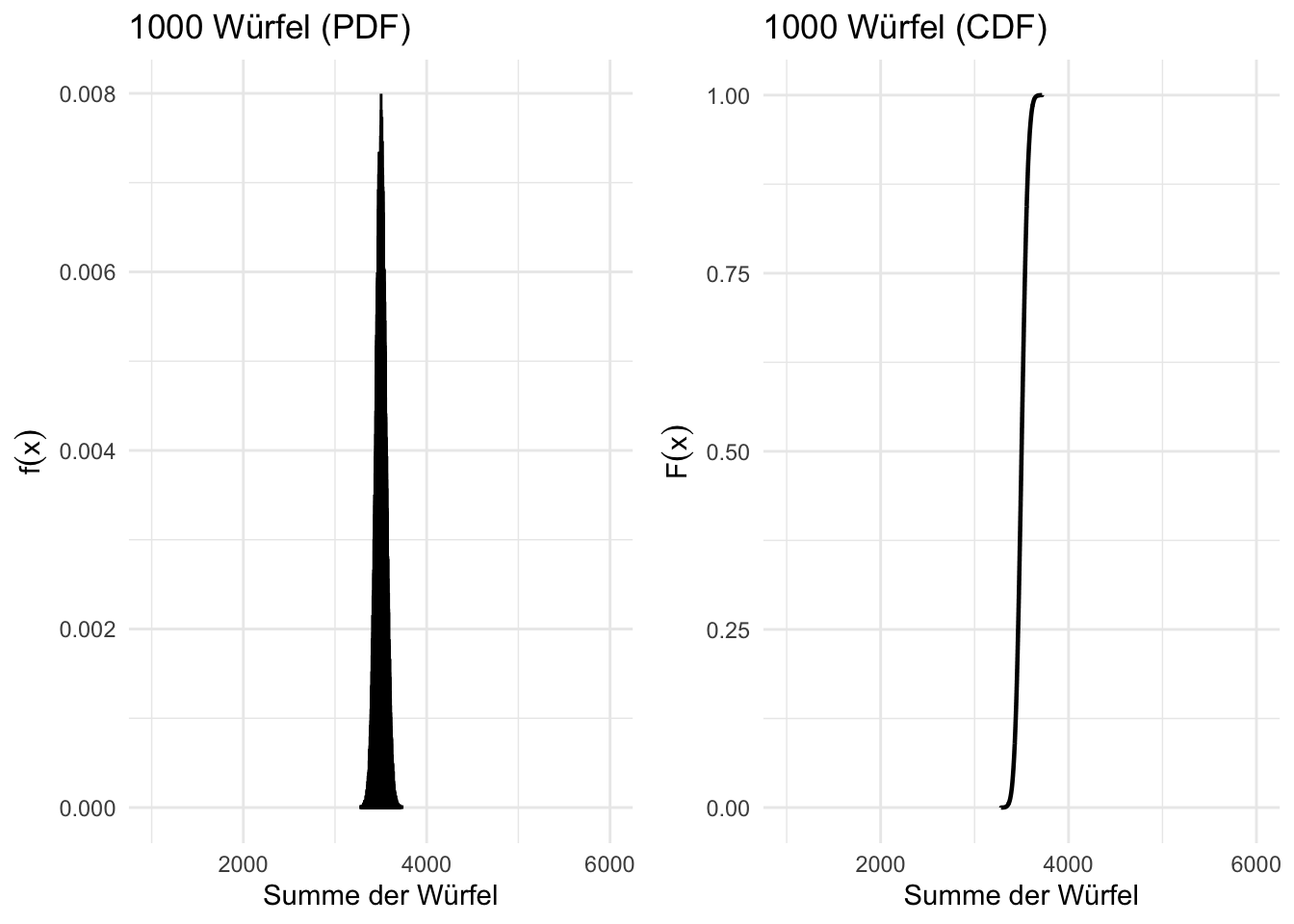
Spannend ist dass die Streuung der Summen extrem klein wird.
Code
# Lade benötigte Paketelibrary(ggplot2)library(dplyr)library(gridExtra)# Parameter definierenn_dice <-1000# Anzahl Würfeln_simulations <-100000# Anzahl Simulationen# Dynamische xlim basierend auf minimaler/maximaler Würfelsummex_min <- n_dice *1# Minimale Summe (alle Würfel = 1)x_max <- n_dice *6# Maximale Summe (alle Würfel = 6)# Funktion zur Simulation der Würfelsummen und Berechnung der Wahrscheinlichkeitensimulate_dice <-function(n_dice, n_simulations) {# Simulation: Summe von n_dice Würfeln pro Durchlauf rolls <-replicate(n_simulations, sum(sample(1:6, n_dice, replace =TRUE)))# Häufigkeitstabelle mit Wahrscheinlichkeiten und kumulativen Wahrscheinlichkeiten df <-as.data.frame(table(rolls)) %>%rename(x = rolls, probability = Freq) %>%mutate(x =as.numeric(as.character(x)), # x als numerischprobability = probability /sum(probability), # Wahrscheinlichkeiten normierencumulative_probability =cumsum(probability) # Kumulative Verteilungsfunktion ) %>%arrange(x)return(df)}# Simulation durchführendf_results <-simulate_dice(n_dice, n_simulations)# Wahrscheinlichkeitsfunktion (PDF) plottenplot_pdf <-ggplot(df_results, aes(x = x, y = probability)) +geom_bar(stat ="identity", fill ="skyblue", color ="black", width =0.7) +labs(title =paste(n_dice, "Würfel (PDF)"),x ="Summe der Würfel",y =expression(f(x)) ) +theme_minimal() +# x-Achse dynamisch setzenxlim(c(x_min, x_max))# Kumulative Verteilungsfunktion (CDF) plottenplot_cdf <-ggplot(df_results, aes(x = x, y = cumulative_probability)) +geom_step(linewidth =0.8, color ="black") +labs(title =paste(n_dice, "Würfel (CDF)"),x ="Summe der Würfel",y =expression(F(x)) ) +theme_minimal() +ylim(0, 1) +# x-Achse dynamisch setzenxlim(c(x_min, x_max))# Beide Plots nebeneinander ausgebengrid.arrange(plot_pdf, plot_cdf, ncol =2)
Abbildung 7.4: Diskrete Wahrscheinlichkeits- und Verteilungsfunktionen für 1000 Würfel (Berechnet mit 100’000 Simulationen)
Der Zentrale Grenzwertsatz besagt, dass die Summe von unabhängigen, identisch verteilten Zufallsvariablen mit wachsendem \(n\) gegen eine Normalverteilung konvergiert.
library(ggplot2)library(gridExtra)# Erzeugung der Normalverteilungx <-seq(-4, 4, length.out =1000)y_pdf <-dnorm(x, mean =0, sd =1)y_cdf <-pnorm(x, mean =0, sd =1)# Datensätze erstellendf_pdf <-data.frame(x = x, y = y_pdf)df_cdf <-data.frame(x = x, y = y_cdf)# PDF Plotplot_pdf <-ggplot(df_pdf, aes(x = x, y = y)) +geom_ribbon(data =subset(df_pdf, x >=-3& x <=3),aes(ymin =0, ymax = y, fill ="99.73%")) +geom_ribbon(data =subset(df_pdf, x >=-2& x <=2),aes(ymin =0, ymax = y, fill ="95.45%")) +geom_ribbon(data =subset(df_pdf, x >=-1& x <=1),aes(ymin =0, ymax = y, fill ="68.27%")) +geom_line(linewidth =1) +geom_vline(xintercept =c(-3, -2, -1, 1, 2, 3), linetype ="dashed", color ="gray40") +labs(x ="Standardabweichungen (σ)", y ="f(x)",title ="Dichtefunktion") +scale_x_continuous(breaks =-3:3,labels =paste0(c("-3", "-2", "-1", "0", "1", "2", "3"), "σ")) +scale_fill_manual(values =c("68.27%"="#2C7BB6","95.45%"="#81B9D9","99.73%"="#D1E5F0" )) +theme_minimal() +theme(panel.grid.minor =element_blank(),legend.position ="bottom",legend.title =element_blank() )# CDF Plotplot_cdf <-ggplot(df_cdf, aes(x = x, y = y)) +geom_line(linewidth =1) +geom_vline(xintercept =c(-3, -2, -1, 1, 2, 3), linetype ="dashed", color ="gray40") +labs(x ="Standardabweichungen (σ)", y ="F(x)",title ="Verteilungsfunktion") +scale_x_continuous(breaks =-3:3,labels =paste0(c("-3", "-2", "-1", "0", "1", "2", "3"), "σ")) +scale_y_continuous(breaks =seq(0, 1, 0.2)) +theme_minimal() +theme(panel.grid.minor =element_blank() )# Plots nebeneinander anordnengrid.arrange(plot_pdf, plot_cdf, ncol =2)
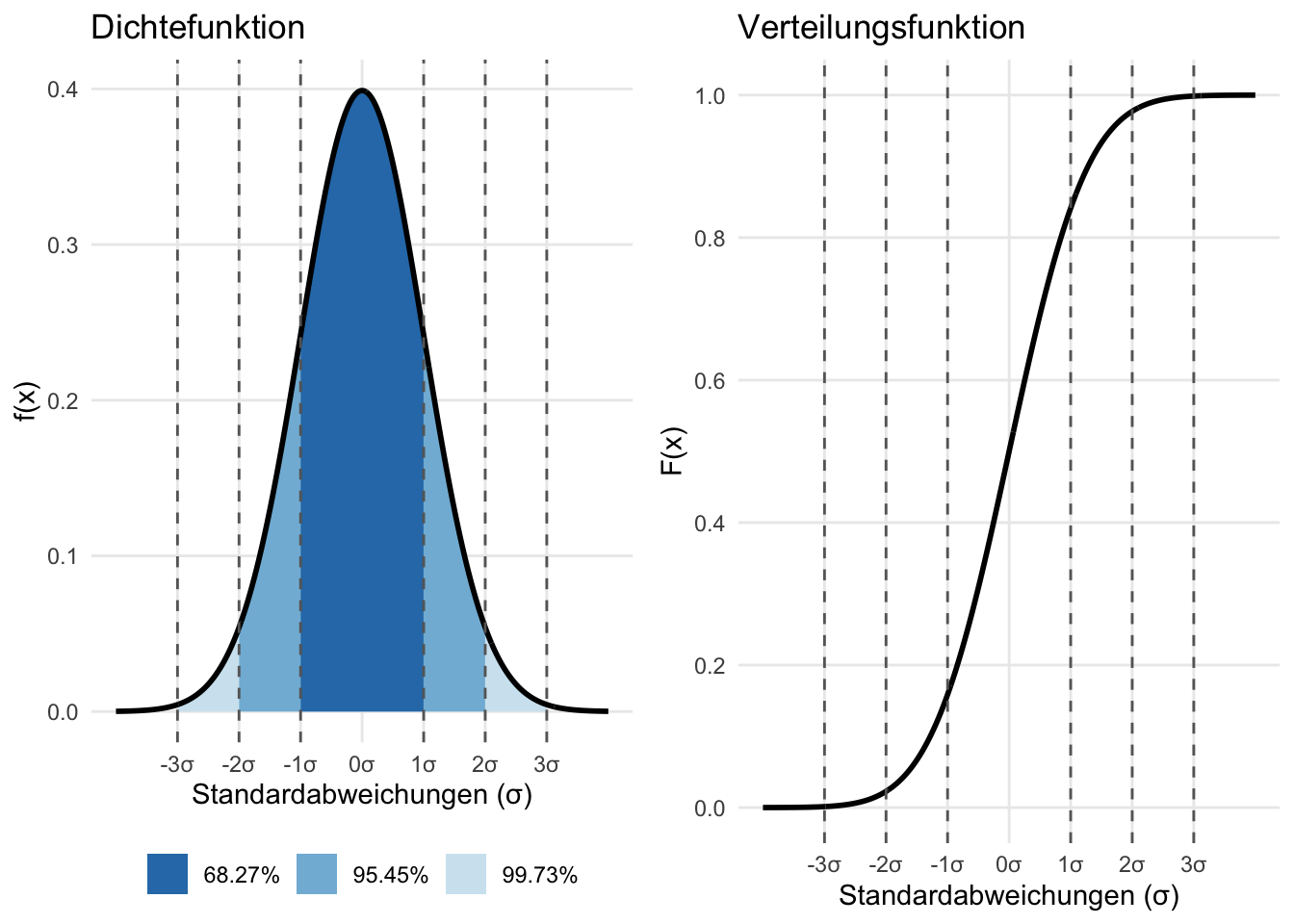
Abbildung 7.5: Links: Wahrscheinlichkeitsdichte (PDF), Rechts: Verteilungsfunktion (CDF) der Normalverteilung
Symmetrisch zur Achse \(x = \mu\)
unimodal mit Maximum bei \(x = \mu\)
Wendepunkte bei \(x = \mu \pm \sigma\)
asymptotisch gegen 0
7.1.2.1 Standardisierung
Durch eine Transformation zu \(\mu = 0\) und \(\sigma = 1\) erhält man eine standardisierte Zufallsvariable.
\[
z = \frac{X - \mu}{\sigma}
\]
Wobei \(z\) die standardisierte Zufallsvariable, \(X\) die ursprüngliche Zufallsvariable und \(\mu\) und \(\sigma\) der Mittelwert und die Standardabweichung der ursprünglichen Verteilung sind.
Die Standardisierung wird verwendet, um verschiedene Elemente (d.h. Daten mit Bias oder unterschiedlichen Einheiten oder unterschiedlicher Varianz, etc.) zu vergleichen.
Beispiel
Angenommen, wir haben eine Stichprobe von 5 Studierenden und ihre Prüfungsnoten (Skala 0–100):